Thursday, October 31, 2013

A new wave of ideas

Though the Internet is only less than half a century old, it is hard to imagine life without it. Society has integrated the World Wide Web into its everyday life, allowing us to relay information faster and more efficiently. From sending emails, to doing research, sharing YouTube videos, and updating your status on Facebook, none of these activities would be possible to do without the Internet. Nowadays it is very easy and common for us to get plugged in. Through laptops, tablets, and even our smart phones, we always have access to the latest information as close as our back pocket. The availability of the Internet creates endless possibilities for new outlets of advertising.

Before the Internet, print advertising was limited to magazines, newspapers, billboards, or posters. It was not very personal and almost out of reach to consumers. What's interesting about current advertising is the ability to interact with it. Facebook is one of the strongest ways to advertise, especially to consumers ages 18-28. The software memorizes your browsing history and is able to show you things that you would be interested in on the sidebars. This isn't that affective and is monster seen as annoying, but the fact that technology has advanced this far is worth noting. The more effective way to utilize social networking is through creating fan pages, events, and sharing. Through fan pages, we are allowed to keep up with current trends in society and get updates about our favorite artists and brands. The ability to share links and pictures,I think, is the most effective form of advertising today. When someone posts pictures of food from a restaurant on Facebook, it's like free advertising for that restaurant! This is also a great way to relay information about exclusive sales or events going on locally. This is more effective than print ads because you're able to see that your friends trust the products being sold. When we see familiar faces using something we haven't used, we have more trust in trying something new.  

The most exciting thing about advertising in this time is the public interactive displays. Using monitors for people to look at or having a way for consumers to use their phones when looking at an ad creates a longer impression on them. It creats new challenges for advertisers and designers to think about. Not only do they think about the design or the message of the advertisement, but they also have to think about the function of the ad - whether it's easy to use or not. 

As a student trying to make it into the industry, it's exciting to think about the latest technology and how there's always something new to create. We've come so far from print design and I can't wait to see what will be the next idea unfold for interactive advertising. 

Tuesday, October 29, 2013

The Good Ol Days


Nostalgia is defined as "a sentimental yearning for the happiness of a former place or time" Nostalgic Advertising utilizes consumer's emotions in order to relay a message that connects them to their past, insisting that buying the product will allow them to relive those moments again.Nostalgia is a powerful tool for advertising because it's a natural instinct.  Naturally, when times are tough and our current financial, emotional, or relational situations aren't what we expected, we tend to look back on the past.  It's easier to think about the times where we had less responsibilities and the future seemed more hopeful.  We can look back and remember being happy and care free.  That is why some of our current advertisements have a retro feel to them, bringing back familiar jingles and characters.  What is trending in fashion has been seen before, reflecting the styles of the 50's where men had nicely combed hair and women wore collared shirts with skirts.  This is not because we have run out of ideas, but because we want to replicate how things were back in those times.  During the 50's,  Americans were coming home after winning WWII.  Not only were husbands reunited with their families, but new inventions were created during wartime and the husbands had money to spend on them. Our current fashion trends follow those of the past to bring back those memories of victory and togetherness.

Nostalgia used in advertising can be beneficial.  It's cheaper to play off of old ideas rather than risking new ones because the older ones already give the product brand equity and high recognition.  People are already familiar with things they've seen before and also makes them feel younger to reminisce.
  This type of advertising wouldn't be as affective if there were negative associations with the product or if it has been altered in a way consumers disagree.  For example, when Coke tried to change its formula to "New Coke", consumers were upset because they liked how their Coke tasted already.  It would be difficult for a nostalgic ad to be successful because it has to be relevant to its target customers and old enough for it to be appreciated as retro, not out-dated.

It would be hard to make nostalgic ads about technology because it is something that is ever-changing.  Usually, technologic ads focus on the potential of the future rather than looking back on its poor graphics and performance.  An example of a current nostalgia ad is the Internet Explorer video.  The tagline of it is "You've grown up, so have we."  Throughout the video, it shows different trends of pop culture with familiar fluorescent colors and soft music in the background.  The ad allows consumers to reminisce on how old computers used to function and reflect on how far technology has come since then.  This ad wouldn't be that successful because looking back on the product, it had horrible performance overall.  Consumers wouldn't be able to see how the speed has changed and instead remember the hard times they had streaming or getting connected to the internet.


Saturday, October 26, 2013

Harley-Davidson Posse Ride


Q: Do you believe brand communities like Harley-Davidson result in greater involvement with the brand?

A: Brand communities are a great way for people to get involved with a brand.  They create a greater sense of belonging between the brand and customer. People who join these communities are the ones who make up the face of the brand.  The motorcycle alone does not make up the brand, but its user –– the cowboy hat wearing, tattooed, bearded, rebellious man is what people think of when HD is mentioned. When these like-minded people create bonds with each other and form a community, they feel like they are part of an exclusive sub-culture. In return, Harley-Davidson could provide services catered to this group such as exclusive offers.

What elements of the Posse Ride do you believe enhance the meaning of the brand for the riders?

A: The Posse oath really enhances the brand.  Oaths mean allegiance and faithfulness when embarking on the journey and makes the consumer feel loyal and of worth.  While on their journey, riders are able to share their stories of their travels.  The bonds that form and the memories that are created as they are on their ride also associates with the brand that brought them together in the first place.

Should Harley-Davidson get more involved in the ride or would that dilute the ride’s meaning to the participants? 

A: I think if they had a proper way of reaching out to them to enhance the experience then it'd be appropriate.  For instance, creating a Facebook event for riders to share their stories or giving them Polaroid cameras to capture their memories would be a good thing.  But they shouldn't do too much to intervene with something that already exists between the riders.


In addition to experiences such as the Posse Ride, what other ways could Harley increase involvement in the brand?

A: The Posse Ride could be taken a step further by turning it into an event like The Amazing Race with an objective for the riders to get from one destination to the other with challenges at each station.


Monday, October 21, 2013

Fun. For your Food.


 Heinz is best known for their ketchup, and in the early 2000's, they launched a new product called EZ Squirt – ketchup in various colors.  This product was marketed towards kids, probably around the ages 5-11 who love to play and get crazy.  With EZ Squirt, kids could dip their fries in purple or have green eggs and green ketchup.  After all, kids love to play with colorful things.

But what Heinz forgot to consider is that it is these kids' parents who the ones who bought the groceries. Ketchup is naturally red, and anything out of that norm just seems odd.  Purple ketchup wouldn't taste like ketchup but perhaps grape or taro.  Green ketchup looks spoiled.  Who would want their children eating such things?  It is simply too bizarre to eat food that is artificially colored.  In addition to its bizarre looks, it is assumed that the artificial colored ketchup also had additional chemicals that were not healthy for their children or additional high-fructose corn syrup, which would lead to their children being more hyper-active.  The commercial campaign also discouraged parents from buying this product for their children because it encouraged naughty behavior.  The commercials would display children using the ketchup to draw on walls or on people with the catch phrase "It's fun, for your food!"  The commercials suggest that buying this ketchup would allow the kids to have more fun because the nozal allows you to squirt precisely but at the same suggests it should only be used on food.  It would be easy for kids to watch this commercial and want to buy the ketchup so they can do the crazy things with it like the kids on TV, which is probably one of the main reasons why parents didn't buy it for their children.

In order for EZ Squirt to be more successful, Heinz should have took parents into consideration.  Parents want the best for their children, so they always want what's most natural. They could have added that this blend of ketchup had less sugar or was made with natural ingredients.

Sunday, October 20, 2013

Pet Fish

Surfrider's mission is the protection and enjoyment of oceans, waves, and beaches through a powerful activist network.  The foundation consists of everyday people — moms, teens, brothers, uncles, anyone who loves the water and being near the ocean.

When we hear of political activism and advertising, we usually think of the serious-toned monologue filled with dramatic pictures and all things negative.  But Surfrider campaigns are different.  Below is a PSA (Public Service Announcement) called "Pet Fish".  The story is about a little girl and her dad flushing her dead pet goldfish down the toilet.  Throughout the PSA, she has a frown on her face, despite all the things her dad tries to do for her to cheer her up.  At the end of the PSA, she screams and we see that the goldfishes they have flushed has washed up on shore right at her feet.  The way this PSA has been executed is successful in my opinion because it takes a serious matter and is able to emphasize its effect on us without having to have serious tones.  It would be tricky to portray such matters with a light heart without disengaging viewers about the issue, but given the target audience of families/people who love the beach, I think it does an excellent job of putting things plain and simple from their perspective.

Wednesday, October 16, 2013

Gender Stereotypes


There are definitely distinguishable differences between men and women that give them their characteristics aside from their genitalia.  Women tend to be more sensitive, caring, nurturing, gentle wife and mother figures whereas men are stronger, more aggressive, success driven and dominating.  Throughout history, we as a society have associated gender with how someone is supposed to act or contribute to the community.  Because women are the ones who carry the baby for 9 months, they have a stronger relationship with their children than their fathers.  Earlier in history, women were the ones to stay home to watch over the baby, do chores, and cook. Between the 1930's-1950's, women were not allowed to pursue higher education or find jobs unless they became teachers or nurses.  At that time, men were the ones to go out to work laborious factory jobs and were the ones to fight during the war. However, times have shifted where women began to fight for their right to vote, to demand their education, and for their right to work.  

Commercials are a result of gender stereotyping because they are adapted to the specific target and act as a reflection of the recipient, either male or female.  The aim of the commercial is not only the satisfaction of needs but also their creation. Women are more often presented in commercials because they are seen as more responsible for making everyday purchases.  Men generally advertise cars, cigarettes, business products whereas women are shown in commercials with cosmetics and domestic products.  It is hard to break away from our deeply rooted perceptions of gender roles, but we have come a long way to break those stereotypes.

The top ad promotes nursing and shows men in different outfits that pertain to their careers with "Are you man enough to be a nurse" in bold and a sub caption that says "If you want a career that demands intelligence, courage, skill and offers unlimited opportunity, consider nursing".  The ad is trying to persuade men to become nurses, suggesting that men who are nurses are just as courageous and smart as men who are fire fighters, businessmen, or athletes.  Our current perception is that nursing is a woman's job because it involves caring for the sick and wearing pure white uniforms.  I think that this ad is successful because it doesn't portray men in a submissive way.  They still retain their look of dominance and strength.

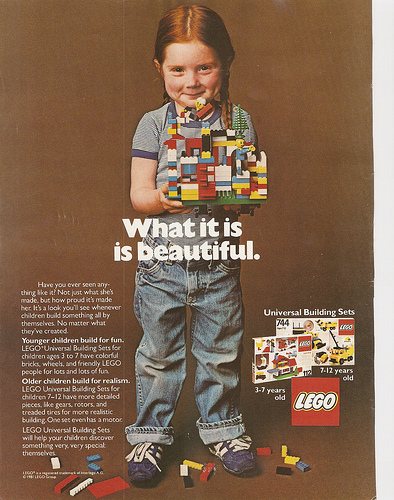
The ad to the right is an ad for lego and shows a girl about the age of 7 or 8 holding her lego creation with the words "What it is is beautiful".  The ad tells us that girls are also allowed to play with legos and don't have to play with dolls in order to be beautiful.  It goes against society's status quo of girls playing with barbies and fake cooking sets to promote creativity and innovation.


Sunday, September 29, 2013

Don't worry, Be Happy


Above is an ad from Volkswagen.  It portrays a white man going about his job at the office talking with a Jamaican accent.  While everyone is going through their normal routines nonchalantly, he is enjoying each part of his day.  In the first part, his coworkers dressed in bland colors complain about it being Monday, but he says "Don't worry, everything will be all right."  That line is taken directly from Bob Marley's song.  At the end of the commercial, Dave is in his beetle with another coworker, who also seems to pick up the Jamaican accent after taking a ride with Dave.

There are a few things I would claim in this ad as stereotypical.   One of the more obvious racial stereotypes are of language and accents. Jamaican accents evoke a sense of happiness and calmness, which is why one was used in this commercial.  At one point, Dave's coworker points out that he is originally from Minnesota, inferring that he should sound normal and American. The reason why he has a different accent is because driving his car gives him joy as if he were relaxing on the beach or on vacation. The commercial played with race further by adding an Asian who also gets the Jamaican accent from the car.

I don't think that this ad is racist because it uses positive stereotypes with irony.  A white man with a Jamaican accent driving a German car doesn't make sense, which makes the commercial funny.  It does not attack the Jamaican culture but instead uses it in a positive note to infer that Jamaicans are generally happy people.  If they were portrayed in the commercial in a negative way such as doing drugs or being lazy, then it would be more offensive.


I think that portraying different cultures and ethnicities in advertising is necessary to show diversity, but should be done in a fashion that does not offend people.  As a society, we have evolved from being segregated to living in a melting pot, and the media should portray that paradigm shift.  We should promote multiculturalism and embrace the things that make each race unique in a way that is encouraging instead of degrading.